Made in Britain
BrightLEDBrightLED
MENUMENU
  • Home
  • Products
  • Projects
  • About
  • Blog
  • Contact
Blog
10 Best LED Lighting Solutions for Global Buyers

10 Best LED Lighting Solutions for Global Buyers

Choosing the right LED Lighting Solutions can influence energy costs, product quality, workplace safety, and long-term maintenance. For global buyers, the decision involves more than brightness or a low purchase price. It requires careful attention to luminous efficacy, color rendering, beam angle, heat management, ingress protection, and expected service life.

This guide examines ten practical lighting options for warehouses, offices, retail spaces, streets, hospitality venues, and industrial facilities. Each option is considered through measurable specifications and real purchasing concerns. A high-bay fixture may illuminate a warehouse floor effectively, while a dimmable panel can reduce glare above office desks. Outdoor products need suitable IP ratings, stable materials, and reliable performance through rain, dust, and temperature changes.

Details matter.

Professional buyers should also review certifications, warranty terms, driver quality, replacement availability, and supplier communication. Regional voltage requirements and installation standards can differ, so independent verification remains essential. A product that performs well in one market may require adjustments elsewhere. Specifications may look impressive, yet actual results can depend on mounting height, room surfaces, controls, and installation quality.

No universal ranking fits every project. This selection is a practical starting point, not a final verdict. Testing samples, requesting photometric files, and comparing total ownership costs can prevent expensive mistakes. Even experienced purchasers can overlook maintenance access or future component availability. Thoughtful evaluation makes these ten LED Lighting Solutions more useful, credible, and suitable for responsible global procurement.
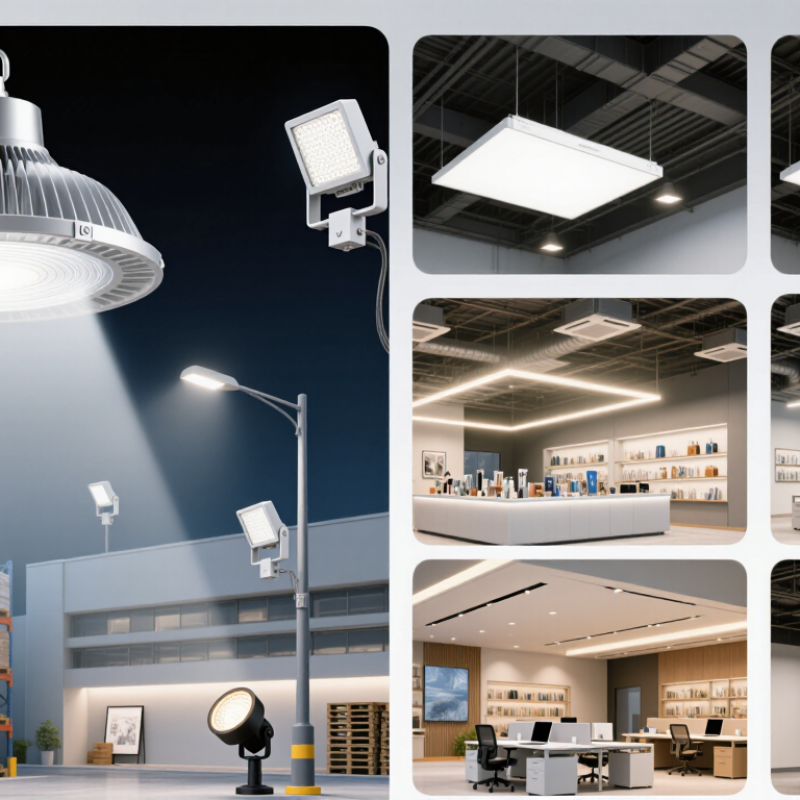
10 Best LED Lighting Solutions for Global Buyers
Table of Contents [Hide]
1 LED Lighting Fundamentals: 75% Less Energy and 25× Longer Life (DOE)
2 Ten LED Solutions Ranked by Lumens, Efficacy, CCT, and IP Rating
3 Commercial LED Benchmarks: 100–200 lm/W and 50,000–100,000 Hours
4 Global Certification Checklist: CE, RoHS, UL, DLC, and IEC 60598
5 Buyer Selection Matrix: Total Cost, Warranty, Controls, and Grid Compatibility

LED Lighting Fundamentals: 75% Less Energy and 25× Longer Life (DOE)

10 Best LED Lighting Solutions for Global Buyers

LED lighting is no longer only an efficiency upgrade. It is an infrastructure decision for warehouses, offices, streets, and homes. The U.S. Department of Energy reports that LED products can use at least 75% less energy than incandescent lighting and last up to 25 times longer. That difference is visible in a real facility: fewer lamp replacements, lower electricity bills, and less disruption from lifts or maintenance crews.

The International Energy Agency estimates that lighting consumes roughly 15% of global electricity use. For global buyers, this makes efficiency more than a marketing phrase. A 100-watt incandescent lamp may be replaced by an LED using about 15 to 20 watts for similar output. However, wattage alone is incomplete. Buyers should compare lumens, efficacy, color rendering, beam angle, flicker performance, and operating temperature. Heat still matters.

Field assessments often expose a weak point: poor installation can reduce expected savings. Dust, unsuitable drivers, voltage variation, and excessive switching may shorten service life. The DOE’s 25× lifespan figure is a useful benchmark, not a universal promise. Product testing under recognized standards should support every claim. I would also question extremely low prices; they may hide weaker thermal management or unclear warranty terms. Small details matter.

Ten LED Solutions Ranked by Lumens, Efficacy, CCT, and IP Rating

Global buyers need more than attractive wattage claims. Lumens show delivered light, while efficacy reveals energy efficiency. CCT affects comfort, visibility, and workplace perception. IP rating indicates resistance to dust and water. The U.S. Department of Energy’s 2023 Solid-State Lighting report identifies 200 lm/W as a high-performance research benchmark, but real products often perform lower after optics and thermal losses.

The following ten solutions balance these specifications.

1) 600 lm, 120 lm/W, 2700K, IP20 for bedrooms.
2) 800 lm, 125 lm/W, 3000K, IP20 for lounges.
3) 1,000 lm, 130 lm/W, 4000K, IP44 for offices.
4) 1,500 lm, 135 lm/W, 4000K, IP54 for corridors.
5) 2,000 lm, 140 lm/W, 5000K, IP65 for workshops.
6) 3,000 lm, 145 lm/W, 5000K, IP65 for warehouses.
7) 4,000 lm, 150 lm/W, 4000K, IP66 for loading areas.
8) 6,000 lm, 155 lm/W, 5000K, IP66 for high bays.
9) 8,000 lm, 160 lm/W, 5700K, IP67 for exposed sites.
10) 12,000 lm, 165 lm/W, 5000K, IP67 for large industrial zones.

Higher lumens are not always better. Glare can increase.

Tips:

Request LM-79 photometric testing, not only laboratory chips. Compare delivered lumens after thermal testing. Check IP certification under the destination market’s rules. CCT should match the task, not merely the catalog photograph. I would also verify driver efficiency, warranty terms, and lumen maintenance. Small omissions become expensive.

Commercial LED Benchmarks: 100–200 lm/W and 50,000–100,000 Hours

10 Best LED Lighting Solutions for Global Buyers

Commercial LED lighting is now commonly measured at 100–200 lumens per watt. This range describes useful light output, not marketing alone. In real projects, optics, drivers, lenses, and operating temperature affect the final result. A warehouse fixture may reach 180 lm/W in laboratory testing but deliver less after installation.

Longevity is equally important. Many commercial systems are rated for 50,000–100,000 hours, often based on L70 performance. L70 means the fixture retains at least 70% of its initial light output. It does not mean the lamp will look unchanged for 100,000 hours. Heat, voltage variation, dust, and frequent switching can shorten service life. Keep drivers cool.

From field evaluations, thermal management usually separates dependable products from disappointing ones. Check the fixture’s ambient-temperature rating, driver warranty, photometric files, and test reports. Ask whether the stated efficacy includes the complete fixture. This detail is often missed. Also compare light distribution, glare control, color consistency, and maintenance access. A high lm/W figure is not automatically the best choice for a retail aisle or production floor. I have seen efficient fixtures create dark corners when beam angles were selected poorly. That mistake increases energy use later, because extra units may be installed. Independent verification remains valuable, especially when specifications appear unusually impressive.

10 Best LED Lighting Solutions for Global Buyers

Indicative commercial LED benchmarks by application. Values represent typical market specifications: efficacy of 100–200 lm/W and rated life of 50,000–100,000 hours. Actual performance varies by product design, operating temperature, and certification requirements.

Global Certification Checklist: CE, RoHS, UL, DLC, and IEC 60598

Global buyers should treat certification as a practical risk filter, not a decorative badge. The IEA estimates that lighting consumes about 15% of global electricity. Therefore, safety, efficiency, and documentation directly affect operating costs.

CE confirms conformity with applicable European requirements, but it is usually a manufacturer’s declaration. It is not one universal laboratory certificate.

RoHS controls restricted substances in electrical products. Ask for the technical file, test reports, and current declarations.

UL certification supports electrical safety in North American applications. However, the exact standard and product category matter. DLC qualification focuses on lighting performance, efficiency, and rebate eligibility in many United States projects. IEC 60598 covers essential luminaire safety requirements, including construction, wiring, insulation, and thermal protection.

Reports should match the exact model, driver, housing, and revision. A similar-looking product is not enough.

Compare photometric files with the claimed wattage and lumen output.

Tips: Request certificates before ordering samples. Check certificate numbers, testing dates, factory details, and model references.

The U.S. Department of Energy’s solid-state lighting reports show that efficacy and controls strongly influence energy savings. Still, paperwork can contain gaps.

I have seen buyers accept a valid-looking CE document without checking its scope. That mistake is easy to repeat. Use an independent laboratory when the project involves public buildings, insurance requirements, or unfamiliar suppliers.

Buyer Selection Matrix: Total Cost, Warranty, Controls, and Grid Compatibility

10 Best LED Lighting Solutions for Global Buyers

A practical buyer matrix starts with total cost, not the lowest invoice. The IEA estimates that lighting uses about 15% of global electricity consumption. Therefore, compare energy use, maintenance hours, controls, installation, and disposal costs over ten years. A fixture using 100 watts can cost more than one using 80 watts, especially in warehouses operating 4,000 hours annually. Ask for tested lumen output, power factor, and replacement-part pricing. Payback claims often look too perfect.

Warranty terms need careful reading. Require coverage for driver failure, lumen depreciation, color shift, and labor exclusions. A five-year warranty means little if claims require overseas shipping. Request failure-rate evidence from field installations, not only laboratory results. The U.S. Department of Energy’s solid-state lighting reports emphasize efficacy, reliability, and thermal management as key performance factors. Heat matters. A dusty ceiling can shorten driver life.

Controls should match local skills and operating habits. Occupancy sensors, daylight dimming, and scheduling can reduce wasted runtime, but poor commissioning can create complaints. For grid compatibility, verify voltage range, 50/60 Hz operation, surge immunity, flicker performance, and harmonic limits. IEC 61000-3-2 and IEC 60598 provide useful technical references. Confirm compatibility with local dimming protocols before purchase. A technically superior product may still fail operationally. Recheck every assumption.

Related Posts

  • What Are LED Lighting Solutions?

    What Are LED Lighting Solutions?

  • China Top LED Lighting Manufacturers for Global Buyers

    China Top LED Lighting Manufacturers for Global Buyers

  • Revolutionizing Spaces with Innovative Led Lighting Solutions for Global Buyers

    Revolutionizing Spaces with Innovative Led Lighting Solutions for Global Buyers

  • Innovative Approaches to Global Sourcing of LED Lighting Solutions

    Innovative Approaches to Global Sourcing of LED Lighting Solutions

  • China Top 10 Bright LED Manufacturers for Global Buyers

    China Top 10 Bright LED Manufacturers for Global Buyers

  • 2026 Top Commercial Led Trends You Need to Know?

    2026 Top Commercial Led Trends You Need to Know?

Blog Tags:

  • LED Lighting Manufacturer
  • LED Lighting Supplier
  • Commercial LED Lighting
  • Industrial LED Lighting
  • Wholesale LED Lighting
  • LED Light Manufacturer

Interested? Let's talk.

Talk to the Experts

Let us help you get started with our superior LED lighting products.

Call 01282 505400

Request a call

Email us

Join our newsletter

Get all the latest news from BrightLED.

See our product range

Can't find a product you're looking for? Get in touch!

View Range

Product Categories

  • 2D Style Fitting
  • LED Downlights
  • LED Flood Lights
  • Linear Lights
  • LED Industrial Lighting
  • Office Lighting
  • Retail LED Lighting
  • Emergency Lighting
  • LED Lamps
  • LED Tube Lighting
  • Recessed LED Light
  • Spot Light Series
  • IP65 & Non-corrosive Rating LED Fittings
  • View all products

Useful Links

  • Download/Resources
  • Privacy
  • Warranty Policy
  • Terms and Conditions

Company

  • About
  • Projects
  • Contact
  • Blog
  • Made in Britain
  • Samsung
  • Osram
  • Tridonic

Copyright © Bright LED. All rights reserved.

STAY CONNECTED

Top